Best Accounting Software for Farms in 2026
Short answer: QuickBooks Online Plus, at $140/mo, is the default once a farm needs to split profit by field, crop, or livestock group with its 40 classes and locations. FarmRaise Tracks Premium, from $36/mo billed annually, generates IRS Schedule F directly and adds USDA grant tracking that QuickBooks does not. Farmbrite bundles livestock or crop production records with accounting from $29/mo, or $119/year for bookkeeping alone. EasyFarm and FarmBooks sell a one-time desktop license instead of a subscription, from $800 on EasyFarm. Xero, Quicken, Zoho Books, Wave, and FreshBooks round out the list for farms whose real need is a general ledger, a combined personal-and-farm file, or straightforward invoicing.
A general ledger can total income and expense. It cannot tell you whether the north 40 or the cow herd made money, and that gap is what farm-specific software closes.

Most farms outgrow a generic ledger the first time a Schedule F needs to show more than one blended number, or the day someone asks whether the north 40 or the cow herd actually paid for itself. QuickBooks Online Plus is the practical default, the plan where up to 40 classes and locations combined let a farm tag a field, a crop, or a livestock group instead of lumping the whole operation into one total.
Toolradar data: 189 of the 267 accounting tools we track are paid-only (71%), while 26% still offer a free or freemium plan.
Toolradar also runs a broader farm accounting guide built around QuickBooks, FreshBooks, Xero, Wave, and Sage as general ledgers with agricultural add-ons. This ranking is for a different question: how those general ledgers actually compare against software written for agriculture from the start, FarmBooks, EasyFarm, FarmRaise, and Farmbrite, where a livestock register, Schedule F generation, or a one-time desktop license change the decision. A farm that only wants the cheapest plain ledger should read that guide instead.
FarmRaise generates Schedule F straight from categorized transactions, a form none of the general ledgers in this list produce on their own. Farmbrite is the pick when livestock or crop production records need to live in the same file as the books. Other ledgers sit in the accounting catalog. How we chose: these 10 were scored for farms that need either agricultural-specific tracking or a straightforward file a Schedule F preparer can open, from the 267 accounting tools in the catalog. Every price was confirmed on each vendor's own site in September 2026, and no placement was paid.
Top Picks
Picked by editorial review, informed by G2 and Capterra review volume and rating and by media mentions, the signals behind our category rankings. How we rate
| Tool | Starting price | Rating | Best for |
|---|---|---|---|
| QuickBooks Online | From $140/mo (Plus) | 4.4405 reviews | Farms whose accountant already closes the file in QuickBooks and needs enterprise tags. |
| Farmbrite | From $29/mo (Essentials) | 4.878 reviews | Farms that want livestock or crop records living in the same file as the accounting. |
| FarmRaise | From $36/mo, billed annually | n/a | Farms that want Schedule F generated automatically and USDA program alerts in one app. |
| Xero | From $25/mo (Early) | 4.45,158 reviews | Farms that want no per-user fee as family members or hired managers need access. |
| EasyFarm | One-time, from $800 (Lite) | n/a | Farms that want to own their accounting software outright with no monthly bill. |
| FarmBooks | One-time license per farm | n/a | Farms that want farm-specific bookkeeping with no monthly subscription. |
| Quicken (Business & Personal) | $4.99/mo first year, then $8.99/mo | 3.928,283 reviews | Small or part-time farms that want the farm and personal finances in one file. |
| Zoho Books | From $15/mo, billed annually | 4.41,009 reviews | Small farms that want a lower organization fee and no farm-specific features to pay for. |
| Wave | Pro is $19/mo | 4.32,059 reviews | A solo or small farm that needs a basic ledger and invoicing before paying for software. |
| FreshBooks | From $43/mo, 50 clients | 4.55,507 reviews | Farms that sell direct to consumers and need recurring invoices more than enterprise tags. |
Farms whose accountant already closes the file in QuickBooks and needs enterprise tags.
Watch out
50% introductory discount expires after 3 months, doubling your bill overnight
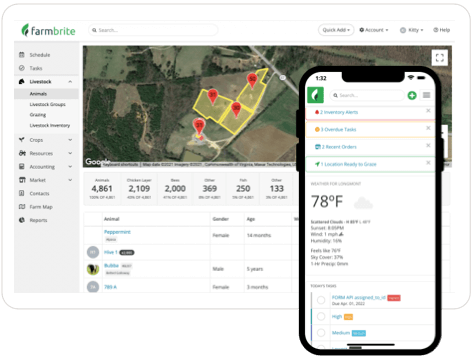
Farms that want livestock or crop records living in the same file as the accounting.
Farmbrite offers a fair to slightly expensive pricing structure, especially for smaller operations.
Farms that want Schedule F generated automatically and USDA program alerts in one app.
FarmRaise's pricing is fair for its niche.

Farms that want no per-user fee as family members or hired managers need access.
Watch out
Potential add-on costs for specific integrations
Farms that want to own their accounting software outright with no monthly bill.
The price is generous for the feature set, especially with inventory and production records included.
Farms that want farm-specific bookkeeping with no monthly subscription.
This is best for single or multi-farm operators wanting industry-specific ledgers without monthly subscriptions.
Quicken (Business & Personal)
- 3.6 on Trustpilot (27,672 reviews)
- 3.9 on Capterra (468 reviews)
- 4.3 on G2 (76 reviews)
- 4.3 on SourceForge (67 reviews)
Small or part-time farms that want the farm and personal finances in one file.
It's best for individuals and small business owners looking for comprehensive financial tools without a high monthly commitment.

Small farms that want a lower organization fee and no farm-specific features to pay for.
Zoho Books is the best value in cloud accounting.
Watch out
Additional users cost $2.50/user/month on top of plan price

A solo or small farm that needs a basic ledger and invoicing before paying for software.
Wave's Starter tier is incredibly generous, offering unlimited invoicing and bookkeeping for free, which is rare in the market.

Farms that sell direct to consumers and need recurring invoices more than enterprise tags.
FreshBooks' pricing is fair for small businesses, though it can become expensive as client numbers grow.
Watch out
Potential for add-on service costs
What accounting software for a farm is
Accounting software for a farm is the ledger that turns planting, harvest, livestock sales, and government payments into a Schedule F an accountant can file, split by field or enterprise instead of one number for the whole operation.
A farm file needs three things a retail or service ledger does not: an enterprise tag for each crop, field, or livestock group, an inventory unit that counts bushels or head instead of generic line items, and a place for USDA payments, crop insurance proceeds, and equipment depreciation to sit beside ordinary income and expense. Leave any one of those in a spreadsheet and profit by enterprise is a guess at tax time.
These ten tools split into three groups. FarmBooks, EasyFarm, Farmbrite, and FarmRaise are built for agriculture first, with a livestock register, crop records, or Schedule F generation native to the product. QuickBooks Online, Xero, Zoho Books, Wave, and FreshBooks are general ledgers a farm can adapt with classes, locations, or tags. Quicken sits between the two, built for a household but able to run Schedule F for a small or part-time operation alongside personal finances.
A farm that only wants a bare-bones profit and loss with no agricultural features should use the small-business accounting guide. Payroll for a seasonal or hired crew is a separate question, covered in the payroll guide.
Why a generic ledger runs out at harvest
The expensive mistake is buying a ledger with no enterprise tracking because the invoice screen looks finished. QuickBooks Simple Start and Essentials, at $38/mo and $85/mo, have no classes or locations, so every field and every livestock group lands in one blended total until the farm upgrades to Plus.
Plus is the QuickBooks tier that adds up to 40 classes and locations combined, enough to tag a modest rotation of fields or a few livestock groups. A row-crop operation running several crops and a herd across a dozen fields can exhaust that cap and needs Advanced, at $340/mo, for an unlimited list.
Xero avoids the per-user fee that multiplies as more family members or hired managers need a login, but Established still has no livestock register or crop inventory unit built in. Early, at $25/mo, stops at 20 invoices and 5 bills a month, a cap a CSA or a farmers market stand selling to dozens of buyers can burn through before the season ends.
FarmRaise and Farmbrite solve the tagging problem from the other direction: each is built for agriculture first and adds general ledger functions around it. FarmRaise generates Schedule F directly from categorized transactions, and Farmbrite's Essentials plans bundle up to 300 head of livestock or season planning for 200-plus crop types with the accounting. Neither replaces a payroll system for a hired crew; that stays a separate line in the payroll guide. Read QuickBooks vs Xero before locking in the general ledger.
Key Features to Look For
Schedule F built into the file (Essential)
FarmRaise generates IRS Schedule F directly from categorized transactions. Quicken Business & Personal reports Schedules C, E, and F the same way. QuickBooks, Xero, Zoho Books, and Wave export data a tax preparer can map to Schedule F, but none produces the form itself.
Enterprise, field, or livestock tagging (Essential)
QuickBooks Plus and Advanced use classes and locations, up to 40 combined on Plus and unlimited on Advanced, to split profit by field or herd. Farmbrite and EasyFarm Pro Livestock go further with a dedicated livestock register tracking sales, purchases, raised animals, and breeding records.
Farm-specific inventory units (Essential)
General ledgers count line items, not bushels or head. Farmbrite's Crop Grower plans cover 200-plus crop types, and EasyFarm's livestock editions track animal inventory by sale, purchase, and birth, which a QuickBooks or Xero file has to approximate with a generic inventory item.
One-time license or a subscription (Important)
EasyFarm and FarmBooks sell a one-time desktop license instead of a recurring fee, which suits a farm that wants to own the software outright. Every other tool in this guide bills monthly or annually, and getting new tax-year forms on EasyFarm or FarmBooks still depends on a paid update.
USDA and grant program tracking (Important)
FarmRaise includes access to a farm funding library that flags USDA grant and cost-share programs alongside the bookkeeping, a feature none of the general ledgers in this guide publish. A farm chasing conservation or disaster payments benefits from having that tracking in the same file as the books.
Payroll for a seasonal or hired crew (Important)
EasyFarm's Plus edition and higher add payroll for the one-time license fee. Wave, Zoho Books, and FreshBooks charge a separate payroll add-on, and Xero's payroll runs through Gusto as an optional line. Price payroll beside the ledger, never assume it is included.
Offline and mobile access (Nice to have)
FarmRaise works from a phone or tablet in the field and states it connects to more than 12,000 financial institutions for bank feeds. FarmBooks and EasyFarm are desktop programs that run without an internet connection but ship no dedicated mobile companion app in their base license.
What a farm should settle before the demo
If a US accountant already closes the file in QuickBooks, start the quote at Plus so classes can tag fields or livestock groups, and move to Advanced only when that 40-item cap is the actual constraint.
If the real question is Schedule F and USDA grant tracking rather than a general ledger, price FarmRaise Premium before buying a bookkeeping add-on for a farm-management tool that was not built for tax forms.
If livestock or crop production records need to live beside the books, not in a second app, compare Farmbrite's Essentials plans against its Accounting Only tier before assuming you need the full production suite.
If the farm wants to own the software with no recurring bill, price EasyFarm's edition against your enterprise list. Lite has no payroll or class tracking, and Pro Livestock adds the livestock register.
If the books also cover the household and not only the farm, Quicken Business & Personal reports Schedule C, E, and F from one subscription instead of running a separate consumer app beside the farm ledger.
Evaluation Checklist
On QuickBooks, confirm Plus or higher before assuming class tracking exists. Simple Start and Essentials have no classes or locations.
On Xero, count expected monthly invoices and bills against Early's 20-invoice, 5-bill cap before choosing it over Growing or Established.
On FarmRaise, confirm whether the quote is Premium Monthly or Premium Yearly, since the annual rate is $4/mo cheaper, and ask whether Financial Planning is bundled or a $549/yr add-on.
On Farmbrite, pick the Livestock, Crop Grower, or Complete track that matches the farm, then check the active-animal or inventory cap on Essentials against your actual headcount.
On EasyFarm, list every module the farm needs (payroll, cost centers, livestock, crops) before buying, since Lite excludes all of them and each is a separate, higher-priced edition.
On FarmBooks, ask directly about the current single-farm license fee, the annual renewal, and the added cost for a second farm entity before budgeting.
On Quicken, confirm the Business & Personal tier, not Classic Deluxe or Premier, if Schedule F and up to 10 businesses per subscription are the requirement.
On Zoho Books, Wave, or FreshBooks, treat the plan as a general ledger only. None lists a livestock, crop, or USDA feature, so agricultural tracking has to be built with classes, tags, or a separate app.
Pricing Overview
Farm-specific bookkeeping
Roughly $30 to $40/mo
General ledger with class tracking
QuickBooks Plus for up to 40 classes and locations, and Xero Established for a farm that wants no per-user fee.
Roughly $90/mo and up
One-time desktop license
Per edition, or a per-farm fee
Combined household and farm
Quicken Business & Personal when Schedule F should sit beside personal finances in one subscription.
$4.99 to $8.99/mo
Budget or free general ledger
Wave Starter and Zoho Books Free before bank import or multiple users matter, and FreshBooks for invoicing a CSA or farm stand.
$0 to $70/mo
Pricing Comparison
| Tool | Published price | What that price buys | Billing |
|---|---|---|---|
$140/mo Plus | 40 classes and locations combined, plus inventory. Simple Start is $38/mo with no class tracking. | Per organization, monthly | |
Farmbrite | $29/mo Essentials | Livestock (300 animals) or Crop Grower (200+ crop types) records bundled with accounting. Accounting Only is $119/year. | Per farm, monthly or yearly |
$36/mo Premium, billed annually | Schedule F generation, bank feeds across 12,000+ institutions, invoicing, and the funding library. | Per farm, monthly or annual | |
Xero | $90/mo Established | No per-user fee and multiple currencies. Early is $25/mo, capped at 20 invoices and 5 bills a month. | Per organization, monthly |
$800 Lite, one-time | Accounting and inventory only. Plus adds payroll and cost centers. Pro Livestock adds the livestock register. | One-time license | |
One-time per-farm license | Desktop bookkeeping built specifically for farm and ranch operations. Confirm the current price with the vendor. | One-time license | |
Quicken | $4.99/mo first year, Business & Personal | Schedules C, E, and F, invoicing, and up to 10 businesses in one subscription with personal finances. | Annual subscription |
$20/mo Standard, or $15/mo annual | General ledger with no agricultural features. A free plan is available under the revenue cap. | Per organization | |
Wave | Pro $19/mo | Free Starter includes unlimited invoices and bookkeeping records. Pro adds automatic bank import. | Per business, monthly or yearly |
$43/mo Plus, 50 clients | Recurring invoices for CSA or farm-stand billing. Lite is $23/mo for 5 clients. | Per account, monthly |
Vendor sites were read on September 24, 2026, including QuickBooks pricing and FarmRaise pricing. Xero's 90% new-customer discount runs through September 30, 2026. FarmBooks' license fee is not printed above; confirm it directly with the vendor. EasyFarm and FarmBooks are one-time purchases, and every other tool in this table bills monthly or annually.
Mistakes to Avoid
- ×
Buying QuickBooks Simple Start or Essentials for a multi-field operation skips class tracking entirely, because that feature starts only on Plus.
- ×
- ×
Skipping FarmRaise's Schedule F export and re-categorizing everything by hand in a general ledger wastes the one feature built specifically to save that step.
- ×
Assuming EasyFarm's or FarmBooks' one-time price includes every module misses that payroll, cost centers, and livestock tracking are separate, higher-priced editions on EasyFarm, and that a second farm is an added license fee on FarmBooks.
- ×
Picking Xero Early to save on the monthly fee against Established ignores that Early's invoice and bill caps can be exhausted by a single busy harvest month.
- ×
Running the household and the farm through two unrelated apps when Quicken Business & Personal can report Schedule F alongside personal finances from one subscription adds a reconciliation step a combined file would skip.
Expert Tips
- →
Set up classes or a livestock register from day one, because retrofitting a year of transactions into enterprise tags after the fact is the slowest part of switching software.
- →
Ask FarmRaise whether Premium Yearly or Monthly fits your cash flow, since the annual rate saves $4/mo but locks in the commitment before a full growing season is tested.
- →
Confirm the Farmbrite track before you buy, Livestock, Crop Grower, or Complete, since switching after entering a season of data means re-tagging every record.
- →
Get every EasyFarm module in writing before paying, since Lite, Plus, and the Pro editions each add a different combination of payroll, cost centers, and livestock tracking.
- →
Call FarmBooks directly for the current license and renewal fee before budgeting, especially if the operation runs more than one farm entity.
- →
Compare Quicken Business & Personal against a dedicated farm ledger before mixing personal and farm data, since a lender or accountant may want the farm's books to stand alone at tax time. The wider shortlist is the accounting software guide.
Red Flags to Watch For
- !
QuickBooks Simple Start and Essentials, at $38/mo and $85/mo, have no class or location tracking, so buying either to save money still leaves profit unsplit by field.
- !
Xero Early stops at 20 invoices and 5 bills a month, a cap a CSA, farmers market stand, or grain co-op with many small buyers can hit before the season is over.
- !
- !
- !
EasyFarm Lite, the entry edition, excludes payroll, cost centers, enterprise tracking, FINPACK exports, and livestock management, all of which require a higher-priced edition.
- !
None of the five general ledgers here (QuickBooks, Xero, Zoho Books, Wave, FreshBooks) produce Schedule F directly. A farm that wants the form generated in the software, not mapped by an accountant afterward, needs FarmRaise or Quicken Business & Personal.
The Bottom Line
QuickBooks Online Plus is the pick once a farm needs to tag profit by field, crop, or livestock group and an accountant will close the file in QuickBooks. Pay for Advanced when the 40-item class and location cap is the actual constraint, and stay on Simple Start or Essentials only if that tagging does not matter yet.
FarmRaise Premium is the pick when Schedule F and USDA grant tracking matter more than a general ledger's feature list. Farmbrite is the pick when livestock or crop production records need to live beside the books, and its Accounting Only plan fits a farm that only wants the bookkeeping. Xero Established is the pick for a farm that wants no per-user fee as more family or staff need logins.
EasyFarm and FarmBooks are the picks for a farm that wants to own the software with a one-time license instead of a subscription. Quicken Business & Personal is the pick when the household and the farm should share one Schedule F file. Zoho Books, Wave, and FreshBooks are straightforward general ledgers for a farm whose accounting question is the invoice and the bank feed, not the enterprise tag.
Cite this: Toolradar, "Best Accounting Software for Farms in 2026", September 2026. Prices checked on vendor pages in September 2026. No paid placement. Compared with the 267 accounting tools we track.
Frequently Asked Questions
What is the best accounting software for farms in 2026?
QuickBooks Online Plus is the default when a US accountant will close the file and the farm needs to split profit by field, crop, or livestock group with the 40 classes and locations that plan includes. That was confirmed on Intuit's pricing page in September 2026.
FarmRaise Premium is the pick built specifically for Schedule F and USDA grant tracking. Farmbrite is the pick when livestock or crop production records should live in the same file as the books. A farm that only wants a bare-bones ledger should read the small-business accounting guide.
How much does farm accounting software cost in 2026?
September 2026 list prices start with Zoho Books' free plan and Wave's free Starter plan. FarmRaise Premium is $36/mo billed annually or $40/mo month to month, and Farmbrite's Livestock or Crop Grower Essentials plans are priced close to it.
QuickBooks Plus is $140/mo, and Xero Established is $90/mo, both list prices; Xero carries a 90% new-customer discount through September 30, 2026. EasyFarm and FarmBooks are one-time purchases rather than subscriptions, priced by edition. Quicken Business & Personal renews at $8.99/mo after a discounted first year. Prices were confirmed on vendor sites in September 2026.
Is there a free accounting tool for a farm in 2026?
Wave Starter is free with unlimited invoices, bills, and bookkeeping records, and Zoho Books' Free plan covers a single organization under its revenue cap. Neither has agricultural features built in. FarmRaise has no permanently free plan, only a trial, and Farmbrite's 14-day trial needs no credit card but converts to a paid plan afterward.
Does QuickBooks or Xero handle Schedule F for a farm?
Neither generates Schedule F directly. QuickBooks Plus and Advanced use classes and locations to split income and expense by field or enterprise, which an accountant can then map to Schedule F lines. Xero has no livestock or crop inventory unit built in either.
FarmRaise Tracks and Quicken Business & Personal are the two tools in this guide that produce Schedule F, or Schedules C, E, and F on Quicken, directly from categorized transactions.
What is the difference between FarmBooks, EasyFarm, and Farmbrite?
FarmBooks and EasyFarm are desktop programs sold as a one-time license rather than a subscription. EasyFarm's editions range from $800 (Lite, accounting only) to $1,600 (Platinum), with higher tiers adding payroll, cost centers, and a livestock register.
Farmbrite is a cloud subscription starting at $29/mo that bundles livestock or crop production records with accounting, or $119/year for the Accounting Only plan alone. Compare all three against the wider farm accounting guide, which ranks the general ledgers on their own.
Can Quicken replace dedicated farm accounting software?
Quicken Business & Personal, discounted to $4.99/mo the first year before an $8.99/mo regular rate, reports Schedules C, E, and F and covers up to 10 businesses in one subscription alongside personal finances.
It has no livestock register, crop inventory unit, or USDA grant tracking, so a farm with real enterprise complexity outgrows it faster than FarmRaise or Farmbrite would.
Which farm accounting software includes payroll?
EasyFarm's Plus edition and higher add payroll for the one-time license fee. Xero's payroll runs through Gusto as an optional line, and Wave, Zoho Books, and FreshBooks each charge a separate payroll add-on. Full pay-run comparisons are in the payroll guide.
Cite this page: Toolradar, "Best Accounting Software for Farms in 2026", updated September 2026, https://toolradar.com/guides/best-accounting-software-for-farms